
|
PORTRETS OF JOHN DOES - THE SEVENTIES
The initiative for a series of John Does (unknown persons), which were taking their shape in the seventies, can be sought in
Mrsnik's irritation because of the spiritual emptiness of coincidental protagonists out of political circles, published in dailies. It regards the drawings, which in their style represent a reaction to photorealism. Visually they could be compared with computer-scanned photographs, and in the realization with a brief line on computer paper with impressions made by a dot-matrix printer. In this period Mrsnik is already, in search of an original personal artistic expression, intensely dedicated to the relation between the production of a human movement and the production of contemporary technical help. The mentioned portraits are not "real", so called psychological portraits, as the artist didn't have a physical or psychical contact with the people he represented. The forms reflect cold, shelling poises, which slash emptiness behind them. Regarding the contents they are a reflection of the artist's experiences with vapid and trivial socio-political situations and happenings.
FIGURE(DRAWING) - THE EIGHTIES
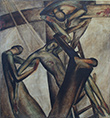
The entire Mrsnik's opus, except for sporadic forms of landscape motives, is based on the figure motive. The 3 half-length "bacon's" portrait's poise develops itself into clearly expressionistic, where the hypnotic look of the protagonist appears, who looks fixedly at the viewer and pours out his fear and need. Only single parts of the face are clearly stressed. Intensive dialog between the viewer and the portrait is being reinstated. Mrsnik (self-)portrait from head's shape, as a synonym of human's residence, gradually dematerialises, abstracts and transforms into a whirling form of a pulsatile tissue. Direct confrontation between the viewer and the portrait is raised onto a higher, esoteric level.
Mrsnik as a graphic artist carries inside by all means the heritage of the graphic school of Ljubljana, where he studied. With his graphic creation, in expressionistic coloured guidelines, first of all from the beginning of the eighties on words, he certainly contributed to the expression of contemporary Slovenian graphics, which he successfully presents at home as in the world.
Above all he creates in the vernis mou technique, where he in soft waxed foundation, covered with paper, notes down a pencil drawing and prints fingers and palms respectively, where the note becomes more direct. Here and there he combines the "vernis mou" technique with aquatint. He achieves different effects with a various paper texture.
GRAPHIC CYCLE " ZAPISI" (Notes) - THE NINETIES
The central form nascently floats in the subtly suggested (residential) space, individual compositions vary. Dynamic happening goes in different directions of space: in vertical and horizontal, in depth and out of it, ... Iconographicly Mrsnik's works speak of life or different forms of living- from connection into daily rhythm of life, to individual philosophical contemplations about existence, which can be in particular examples paralleled to contents of Christian religion and named even: Birth, Assunta, ...
GRAPHIC CYCLE "TISOC IN ENA" (Thousand and One) - THE NINETIES
In the nineties Mrsnik continues with the graphic cycle "Zapisi" and builds his graphic production with technical ( combinations of major numbers of basic graphic plates ) as well as artistic- experimentation with contents, in graphical cycle 1000+1 (Thousand and One)- "Tisoc in ena"- by which he opens to himself as well as to the public, entries of completely new creations and comprehensions, still expressively existential topics.
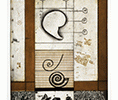
In the recent year blue has settled into the artist's creation, exclusively in shades from expressive black to white, , which on a symbolic level absorbs the viewer into itself and guides him into infinity of living... The artist emphasizes this depth of toned blue universe with the confrontation of small, geometrically correct cut out and limited existential space, with a trace of his presence (fingerprints, psychograms).
The artist decomposes the artistic field in several spaces. On the lower part of the graphics zones with artist's fingers and palms appear in a multitude of impressions. He frequently visualizes nets and pure geometric figures, as metaphors of space (of order, severity, logicality), which is tallied by and full of residential energy. On a symbolic level he creates a dialog between the softness of the organic on one hand and the hardness and severity of the logical order on the other. The note takes over a form of a cocoon, in which pure residential energy is whirling.
DRAWING (LABELS AND COMPUTER PAPER ROLES)- THE NINETIES
Drawings on labels in the metaphorical meaning reflect the author's "struggle for life" or his functioning in contemporary life. It is a sort of "pop art", with a direct note or drawing on label, otherwise typical material, used in today's technology and after all even in the world of consumption.
Labels reinstate a special relation between the artistic work and the visitor. The provoked viewer finds himself in a dilemma, because of the confrontation with the specificity of the exhibit, which he can (if he desires) take, put in a pocket and bring it with him. In this way a new relation between the artistic work and the visitor is reinstated in the show-room - the statistic position of the contemplative viewer in front of the exhibit abolishes, the exhibit becomes mobile.
Similar as with drawings on labels, fragility and vulnerability of the painter's direct drawing note - the so called psychogram - come to expression in the drawings on strips of computer paper. The content happening is strictly demarcated by horizontal line, under which origins of writing appear, that as a sign of human's message and culture note down a reflexion of the above formed materiality.
Small notes on labels or on computer paper rolls as creations belong into the domain of the traditional artistic practice, founded on body movement. Because of the material, on which they are performed on the one hand and because of the possibility of untraditional exhibitioning in a space on the other hand, they reflect a movement in the space. Just because of the confrontation of the direct painting note with ephemeral material of technical use, the expressiveness of Mrsnik's notes is that much stronger. The artist lucidly demonstrates the traditional painting's definition (in this case drawings) in an expressive media of contemporary artistic practice. The drawings on computer paper rolls are interesting as well as the exhibit itself - they can be exhibited in various ways of painting installations, what once again shows a confrontation of the traditional creation with, in the latter decades, topical artistic installations.
The artist has been occupied with the search for original artistic expression, based on the relation problems between traditional artistic practice and the search for new expressive media, in the entire years of his creativeness. Perhaps, by constructing the basic idea of his creativeness, as in the type of drawings as well as in graphics, in his personal authorial development, he just recently achieved that artistic expressive level, which places him among leading contemporary Slovenian creators.
Katja Ceglar
|